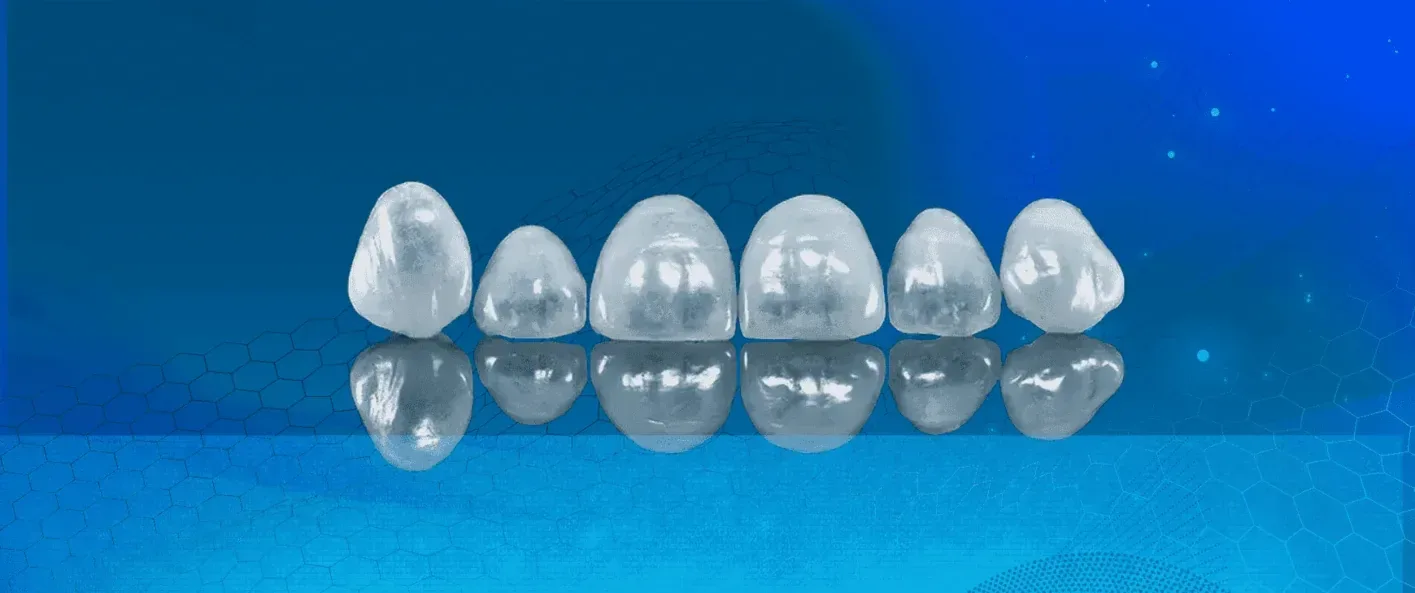
Achieve flawless naturalness in your front teeth with Bursa E max veneer. Lithium disilicate technology, treatment processes, and advantages in this clinical guide!
Smile aesthetics have as much importance in modern dentistry as function. In past years, porcelain with a metal substructure, used to achieve durability, fell short of meeting aesthetic expectations due to the gray reflections they created at the gum line and their matte (light-blocking) appearance. Today, patients demand not only healthy and white teeth, but also restorations so transparent, lively, and natural that it will be absolutely impossible to tell they were "done." This is where Empress Maximum (E-Max) ceramics, the highest technological point reached by aesthetic dentistry, come into play.
Based on the philosophy of biomimicry, that is, directly imitating nature, Bursa E max veneer treatments perfectly replicate the optical properties of natural tooth enamel (light transmittance, fluorescence, and opalescence). It is considered the gold standard especially in restorations of the "smile line" (the anterior incisors), which stand out first during speaking and smiling. Bursa clinics, home to advanced medical equipment and aesthetic dentistry specialists, provide services at international standards in this advanced treatment. In this comprehensive clinical guide, we will examine the scientific features of Bursa E max veneer technology, its structural differences from zirconium, treatment processes, and long-term clinical advantages in all medical details.
E-Max, a groundbreaking material among aesthetic dentistry materials, is a reinforced all-ceramic system that does not contain a high-opacity (matte) substructure such as zirconium or metal. In medical literature, this material is called "Lithium Disilicate Glass Ceramic"; thanks to its crystallized structure, it offers both tremendous aesthetic depth and serious resistance against chewing forces in the anterior region.
A natural tooth enamel does not directly reflect the light falling on it; it absorbs the light, refracts it, and transmits it to the dentin layer, giving the tooth that lively, three-dimensional appearance. The greatest scientific success of Bursa E max veneer applications lies here. Lithium disilicate crystals have exactly the same refractive index as natural enamel. This feature allows the veneer to display a natural brightness and depth under different light sources (sunlight, spotlights, fluorescent light), as if it were your own organic tooth. In addition, thanks to its tissue-friendly (biocompatible) structure, it establishes excellent biological adaptation with the gum (gingiva); it does not cause allergies, discoloration, recession, or inflammation (infection) in the gums.
One of the issues patients are most curious about when planning an aesthetic smile design is whether zirconium or E-Max should be preferred. Although both materials are in the metal-free all-ceramic group, their clinical indications (areas of use) differ from one another. In a competent Bursa E max veneer center, the dentist selects the most appropriate material according to the patient's bite dynamics and caries condition.
In the table below, you can examine the scientific comparison of the clinical features of these two premium materials:
Comparison Criterion | E-Max (Lithium Disilicate Glass Ceramic) | Zirconium Dioxide (All-Ceramic) |
Light Transmittance (Translucency) | Maximum Level (Equivalent to natural enamel) | High / Medium (More opaque than E-max) |
Fracture Strength (Resistance) | 400 - 500 MPa (Very ideal for the anterior region) | 900 - 1200 MPa (Exceptionally strong) |
Tooth Preparation (Invasiveness) | Minimally Invasive (Requires very little reduction) | Moderately Invasive (Requires circumferential reduction of the tooth) |
Ideal Use (Indication) Area | Single-tooth restorations in the anterior region, laminate veneer, inlay/onlay | Posterior molars, long bridges, cases with high occlusal stress |
Bonding Chemistry (Cementation) | Chemically sealed to the tooth (adhesive bonding) | Bonded with traditional or semi-adhesive methods |
Lithium disilicate ceramics are the first choice of dentists in specific clinical situations due to their superior aesthetic properties. The Bursa E max veneer procedure not only addresses aesthetic concerns, but also restores weakened enamel and protects the teeth.
Asymmetries and color changes in the smile line (the front 6-8 teeth) are the areas where E-max is used most:
Advanced Discoloration: For masking teeth that have darkened due to antibiotic use (tetracycline), excessive fluoride intake (fluorosis), or after root canal treatment, and do not respond to bleaching procedures.
Diastema Closure: For the permanent closure of physiological gaps (diastema) between the front teeth that disrupt aesthetics, without the need for orthodontic wire treatment.
Shape and Size Irregularities: For resizing teeth that are genetically small, wedge-shaped, or asymmetrical according to the golden ratio (1.618).
Enamel Cracks and Fractures: For repairing fractures occurring at the incisal edges of the front teeth as a result of trauma, using a material closest to natural tissue.
Modern medicine aims to preserve existing healthy tissue. In traditional zirconium or metal-supported veneers, an average of 1.5 - 2.0 mm of tooth structure must be removed from all surfaces of the tooth to make room for the material thickness. However, in Bursa E max veneer treatments (especially when applied in the form of porcelain laminate), it is sufficient to perform a reduction of only 0.3 to 0.7 mm, as thin as a hair strand, from the front surface of the tooth. The glass-like crystallized structure of E-max ceramics bonds so strongly to the tooth's enamel layer with special chemical agents that the restoration becomes almost an original part of the tooth and the risk of falling off is eliminated.
The days when traditional paste impressions caused nausea are behind us. In modern Bursa E max veneer clinics, the treatment process is carried out in an entirely digital, comfortable, and zero-margin-of-error manner, integrated with Computer-Aided Design and Manufacturing (CAD/CAM) technologies.
A perfect smile cannot be left to chance. In the first session of treatment planning, the dentist takes a 3D measurement of the teeth with micron precision using intraoral optical scanners. Then professional studio photos and videos of the patient are taken from different angles. In the digital environment, E-Max veneers that best suit the patient's facial features, lip support, and skin tone are designed. Before any cutting is done on the teeth, this virtual design is applied to the patient's own teeth with temporary composite materials called "Mock-up." Thanks to this live trial, the patient sees in the mirror the smile they will have when the treatment is complete, and together with the dentist performs speech (phonation) and aesthetic checks. After approval is obtained, the minimal preparation (cutting) of the teeth begins.
After the final digital impression of the prepared teeth is taken, the data is transferred to the 3D milling machines in the laboratory. Pure lithium disilicate blocks are carved without hand contact using microscopic tips and turned into E-max veneers. In the final stage, natural crack effects, translucency transitions, and glaze procedures are applied to the veneers by master ceramists, giving the tooth a soul.
The most vital and technical part of the clinical process is the cementation, that is, the bonding stage. E-max veneers cannot be fixed with standard adhesives. In an environment completely isolated from saliva (under a rubber dam), the inner surface of the veneer is roughened with hydrofluoric acid, while the tooth surface is roughened with phosphoric acid. Using adhesive resin cement (light-cured adhesive), the veneer is almost "fused" to the tooth at the cellular level. This strong bond allows E-max to form an unbreakable integrity despite its thin structure. At the end of this process, which takes an average of 2-3 sessions (7-10 days), the patient achieves a natural and radiant smile that can be used for a lifetime.
This content has been prepared solely to scientifically inform patients and the public about aesthetic dentistry practices and all-ceramic restorations (Lithium Disilicate / E-Max), in full compliance with the provisions of Law No. 1219 on the Practice of Medicine and its Branches and the Regulation on Promotional and Informational Activities in Health Services of the Ministry of Health. The medical information contained herein does not include a definitive diagnosis or a medical treatment guarantee (commitment) for any disease. In order for the suitability of your bite and dental structure for E-max veneer treatment to be scientifically determined, you must consult an expert dentist and undergo an in-person clinical and radiographic examination.
Let us take a look together and go over your treatment options. Feel free to call us with any questions.
 Türkçe
 English